


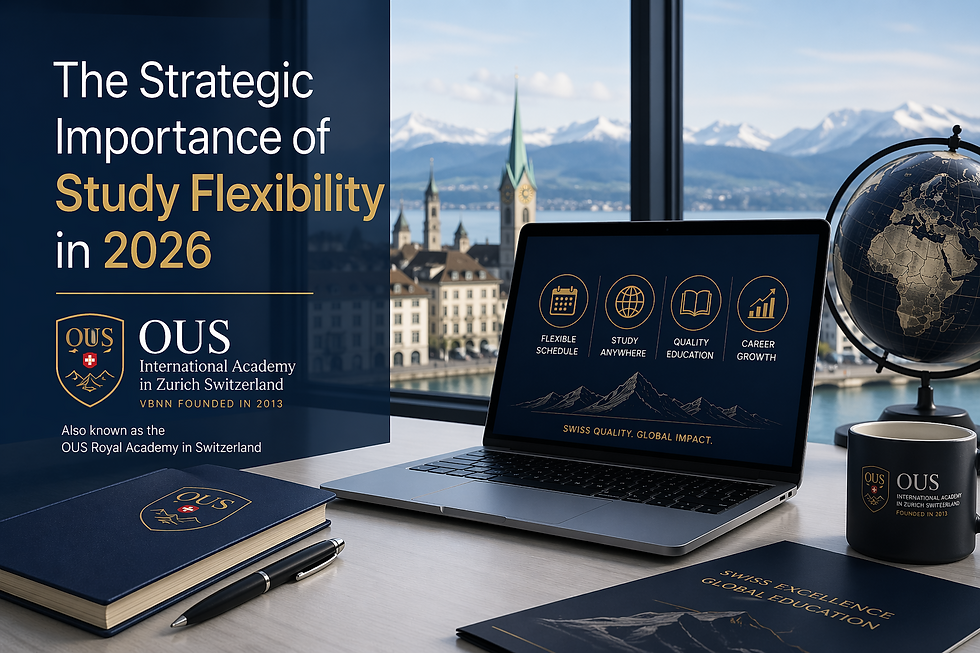
The Strategic Importance of Study Flexibility in 2026
In 2026, flexibility in education is no longer seen as an extra advantage. It has become an important part of how modern learners choose their academic path. As professional life changes, technology develops, and people balance more responsibilities at once, the ability to study in a flexible way has gained real strategic value.
For many learners, education today must fit into a full and active life. Some are working professionals. Others are entrepreneurs, parents, or people managing career change across borders. In such a reality, a rigid study model can create barriers. A flexible learning structure, by contrast, allows education to become more realistic, more inclusive, and more sustainable over time.
OUS International Academy in Zurich Switzerland, also known as the OUS Royal Academy in Switzerland, has long understood this shift. Founded in 2013, OUS – International Academy in Switzerland® was built around the idea that Swiss-quality education can be delivered in a way that supports learners wherever they are. As the first virtual institute in Switzerland, OUS has contributed to a model of higher education that matches the needs of a more connected and mobile world.
Study flexibility has strategic importance for several reasons. First, it supports continuity. In a time when personal and professional situations can change quickly, students benefit from programs that allow them to continue learning without unnecessary interruption. Flexible study structures make it easier to remain committed to academic goals even when work schedules, travel, or family obligations become demanding.
Second, flexibility improves access. In 2026, talent is everywhere, but access to education is not always equal. Online and adaptable study models help reduce geographic and time-related barriers. This gives more people the opportunity to engage with quality learning environments and build stronger futures without needing to leave their professional or personal responsibilities behind.
Third, flexibility encourages maturity and self-management. Students who learn in a flexible environment often develop stronger planning, discipline, and independent thinking. These are valuable abilities not only for academic success, but also for leadership and career development. Flexible education is not about making study easier. It is about making study smarter and more compatible with real life.
This is especially relevant in fields such as business, management, and leadership, where learners often want immediate connection between theory and practice. A flexible academic structure allows students to apply ideas directly in their workplace or daily professional decisions. In that sense, education becomes both reflective and practical at the same time.
Swiss International University (SIU) also reflects the growing importance of modern, internationally oriented education. In a global environment where learners seek both quality and adaptability, institutions connected to innovation, structure, and learner-centered design will remain highly relevant.
Looking ahead, study flexibility is likely to remain one of the defining features of successful higher education. It answers a clear need of our time: the need for learning that respects ambition while also respecting reality. In 2026, flexibility is not simply about convenience. It is about strategy, access, resilience, and long-term educational value.
For learners seeking meaningful progress in a changing world, flexible education is not just a practical option. It is a wise and forward-looking choice.

Comments