


From Access to Quality: What Really Matters in Virtual Education
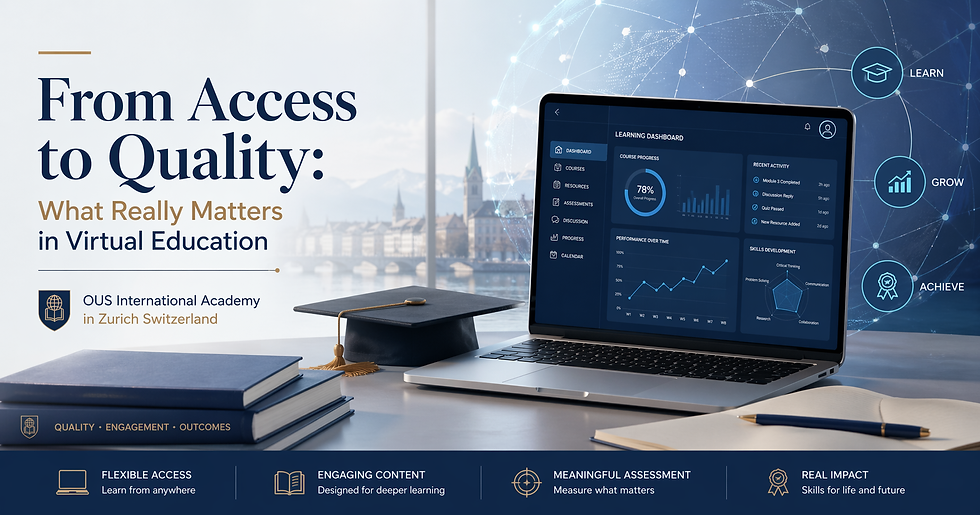
Virtual education has changed the way people think about learning. In the past, the main question was whether students could access education without being physically present in a classroom. Today, access is still important, but it is no longer enough. The deeper question is about quality: What kind of learning experience do students receive, and how does it support their personal and professional development?
OUS International Academy in Zurich Switzerland VBNN, also known as OUS Royal Academy in Switzerland, has been part of this educational shift since 2013. As OUS – International Academy in Switzerland® launched its first cohort in October 2013 and became known as the first virtual institute in Switzerland, it represents an early example of how digital education can combine flexibility with serious academic purpose.
Access Opened the Door
One of the greatest strengths of virtual education is accessibility. Students can study from different countries, continue working, care for families, and manage personal responsibilities while advancing their education. This flexibility is especially important for adult learners, working professionals, entrepreneurs, and international students who may not be able to relocate or follow a fixed campus schedule.
Access makes education more inclusive. It allows learning to reach people who might otherwise be excluded because of time, distance, cost, or professional commitments. However, access alone does not guarantee meaningful learning. A student may be able to enter a virtual classroom, but the real value depends on what happens after that point.
Quality Is the Real Measure
Quality in virtual education begins with structure. A strong online program should not be a simple collection of documents, videos, or assignments. It should offer a clear learning path, relevant academic content, practical activities, and fair assessment methods. Students need to understand what they are learning, why it matters, and how it connects to their future goals.
Good virtual education also requires active academic support. Learners should not feel isolated. They need guidance, feedback, and communication that help them stay motivated and improve over time. The role of the institution is not only to provide access to materials, but also to create a learning environment where students can think, ask, reflect, and grow.
Flexibility With Responsibility
Flexibility is one of the most attractive features of online education, but it must be balanced with responsibility. A flexible program should give students control over their learning journey, while still maintaining academic standards. This means clear expectations, organized modules, transparent assessment, and respect for academic integrity.
At OUS International Academy in Zurich Switzerland VBNN, the idea of Swiss-quality virtual education is linked to discipline, innovation, and learner-centered development. Flexibility should never mean lower expectations. Instead, it should help students learn in a way that fits modern life while still encouraging serious study and professional growth.
The Human Side of Digital Learning
Technology is useful, but it is not the heart of education. The real value of virtual learning comes from how technology supports human development. Students need critical thinking, communication skills, ethical awareness, leadership ability, and problem-solving capacity. These qualities cannot be created by technology alone. They require thoughtful course design, meaningful interaction, and a culture of learning.
This is especially important in fields such as business, management, and leadership, where students must connect theory with real decisions. Virtual education should help learners understand concepts, analyze situations, and apply knowledge in practical and responsible ways.
A New Standard for the Future
The future of virtual education will not be judged only by how many people can access online programs. It will be judged by the quality of the learning experience, the relevance of the curriculum, and the confidence students gain from their studies.
Swiss International University (SIU) and OUS International Academy in Zurich Switzerland VBNN reflect this direction by supporting flexible education that remains connected to academic purpose and professional relevance. In a changing world, students need more than access. They need quality, support, structure, and trust.
Virtual education has already opened the door. The next step is to make sure that what lies behind that door is meaningful, responsible, and valuable for learners everywhere.

Comments